

Mineral processing facilities worldwide are increasingly challenged to improve recovery rates, reduce operational costs, and meet stringent product specifications. With declining ore grades and more complex mineral compositions, conventional separation methods often struggle to achieve optimal results. Flotation technology has emerged as a core process for the extraction of fine and valuable minerals from gangue. The XJF Series Flotation Machine for Industrial Mineral Processing provides a robust solution for large-scale operations requiring precise, efficient, and stable mineral separation.
Modern industrial mineral processing plants must address multiple challenges simultaneously: high-volume throughput, variable ore characteristics, and environmental regulations. Base metals such as copper, lead, and zinc, as well as precious metals like gold and silver, require precise separation to maximize recovery and concentrate quality. Similarly, non-metallic minerals including barite, fluorite, and phosphate depend on flotation for consistent product specifications. As ore grades decline and feed complexity increases, flotation machines capable of handling fine particles with controlled hydraulic and mechanical performance are in higher demand. The XJF series is designed to meet these operational pressures, ensuring stable recovery and energy-efficient operation.
The XJF Flotation Machine operates on the principle of froth flotation, which separates minerals based on differences in surface chemistry and hydrophobicity. Mechanically agitated tanks generate a uniform slurry environment, while dispersed air bubbles selectively attach to hydrophobic particles, forming a froth layer that is subsequently collected as concentrate. The XJF Series Flotation Machine for Industrial Mineral Processing integrates optimized impeller and stator designs that enhance bubble distribution, minimize dead zones, and improve particle-bubble collision efficiency. Adjustable operational parameters, including impeller speed and air flow rate, allow precise tuning for varying ore types and particle sizes, ensuring maximum recovery and concentrate consistency.
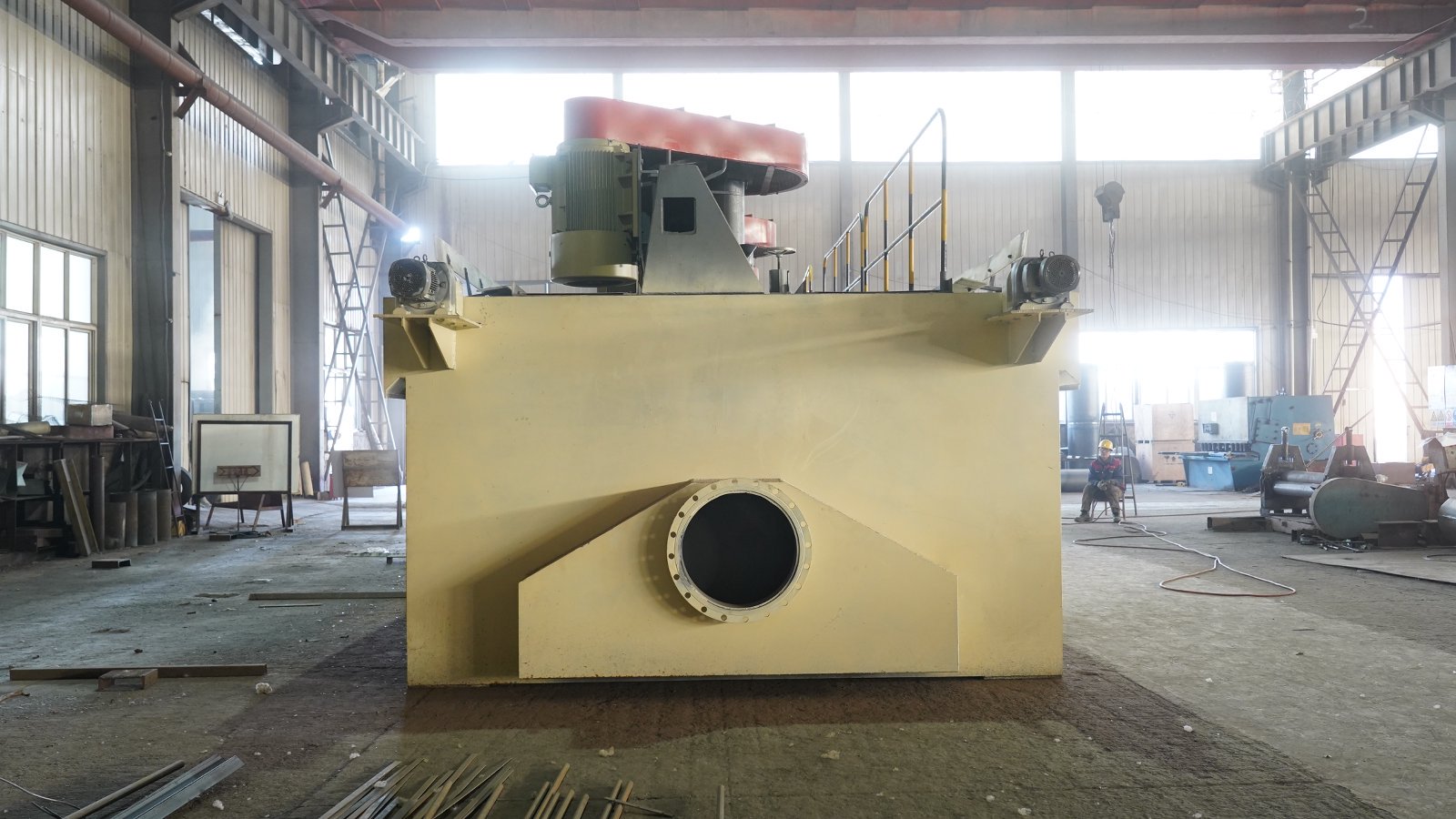
The structural integrity and material selection of XJF flotation machines are critical for long-term operational reliability. The machine body is fabricated from reinforced steel to withstand continuous slurry load and vibration. Wear-prone components such as impellers, stators, and tank liners are constructed from high-hardness alloys or lined with abrasion-resistant polymers to extend service life. Precision manufacturing techniques, including CNC machining and controlled welding, ensure uniform impeller geometry and tank alignment, which reduces mechanical wear and maintains stable flotation performance. Uniform pulp mixing, minimal turbulence, and consistent air dispersion are achieved through these design considerations, which are essential for industrial-scale mineral processing.
The performance of the XJF series is affected by multiple operational factors:
Particle Size Distribution: Uniform separation requires controlled agitation tailored to fine and medium particle fractions.
Slurry Density and Viscosity: Optimal pulp density ensures effective bubble-particle interactions; deviations can reduce recovery or froth stability.
Air Flow and Agitation: Precise control of air introduction and impeller speed maintains bubble size and distribution, directly affecting separation efficiency.
Reagent Application: Proper selection and dosing of collectors, frothers, and modifiers are essential to achieve target recovery and concentrate quality.
Regular monitoring, calibration, and adjustment of these parameters help maintain consistent flotation efficiency and product specifications.
When procuring XJF flotation machines, industrial operators should evaluate suppliers based on:
Process Expertise: Manufacturers with strong mineral processing knowledge provide process optimization recommendations.
Manufacturing Standards: Adherence to ISO or equivalent standards ensures component consistency and reliability.
Technical Support: Commissioning assistance, training, and spare part availability minimize operational risks.
Proven Applications: Demonstrated performance in similar ore types and plant capacities provides confidence in long-term reliability.
A capable supplier ensures seamless integration of flotation machines into plant operations and maximizes equipment life cycle value.
Even with advanced designs, flotation machines face operational challenges. High abrasive feed can accelerate wear of impellers and liners. Inconsistent feed characteristics or fluctuations in water chemistry can destabilize froth, reducing recovery. Poor maintenance or misalignment of mechanical components can compromise efficiency. Addressing these challenges requires robust maintenance protocols, operator training, and periodic process audits to ensure stable performance.
The XJF Series Flotation Machine for Industrial Mineral Processing is used extensively in base metal, precious metal, and non-metallic mineral processing plants. Copper concentrators employ XJF machines to recover fine sulfide particles, increasing overall yield. Gold processing facilities utilize the machines to capture fine gold associated with sulfide minerals. In zinc and lead operations, the XJF series improves concentrate quality by efficiently separating gangue from target minerals. Its adaptability makes it suitable for various plant sizes, ore types, and operational conditions, demonstrating broad industrial applicability.
The mineral processing industry is moving toward automation, digital monitoring, and energy-efficient operations. Modern XJF machines increasingly incorporate sensors to monitor slurry density, air flow, and froth characteristics in real time. Data-driven adjustments enable operators to optimize recovery rates while reducing energy consumption. Development of advanced wear-resistant materials for impellers and liners extends equipment life and lowers maintenance costs. As processing plants face declining ore grades and more complex feed compositions, high-performance flotation machines like the XJF series will play an increasingly important role in sustainable, efficient mineral extraction.
Q: What ores are suitable for XJF flotation machines?
A: The XJF series is suitable for base metals, precious metals, and non-metallic minerals requiring precise fine particle separation.
Q: How does XJF improve recovery compared to conventional flotation machines?
A: Optimized impeller design, precise air distribution, and adjustable agitation parameters enhance bubble-particle interaction, improving recovery and concentrate quality.
Q: Can XJF machines operate continuously in industrial plants?
A: Yes, they are designed for continuous operation with robust construction and stable hydraulic performance.
Tel : +86-315-5282855
E-mail : jinzexuanmeijixie@gmail.com
Address : 1.6 km south of Xinjichang Road,
Tangshan City, Hebei Province, China

Copyright © 2017.Company name All rights reserved.More Templates


Энэ вэб сайт нь таныг манай вэбсайтаас хамгийн сайн туршлагыг олж авахын тулд күүки ашигладаг.

 English
 Español
 Pусский
 Tiếng Việt



 Whatsapp
 Утас
Утас